

AMD Ryzen 3 2200G and Ryzen 5 2400G APU Preview

Introduction
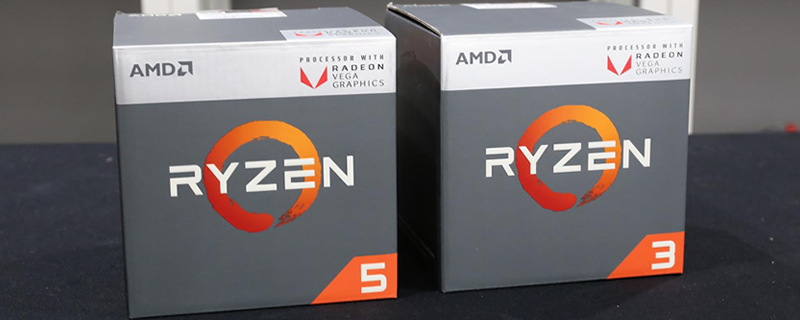
Today is unboxing day for the Ryzen 3 2200G and the Ryzen 5 2400G, leaving us in a tricky position where we are allowed to show you guys the product, but in a situation where we are not allowed to tell you guys about the finer details.
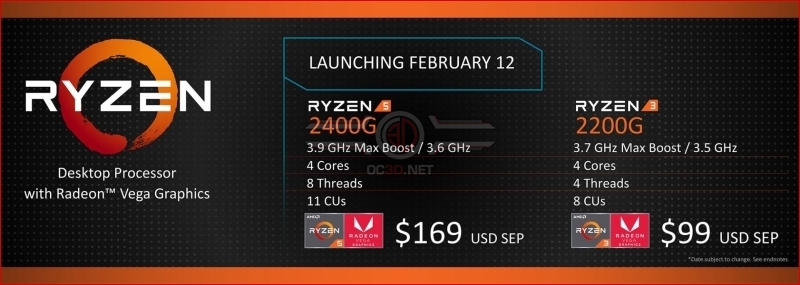
We will have a review out for both of these CPUs on February 12th, but for now, we can discuss everything that AMD has made public so far, including a comparison on the specifications of these APUs and Microsoft’s current generation Xbox One S console.
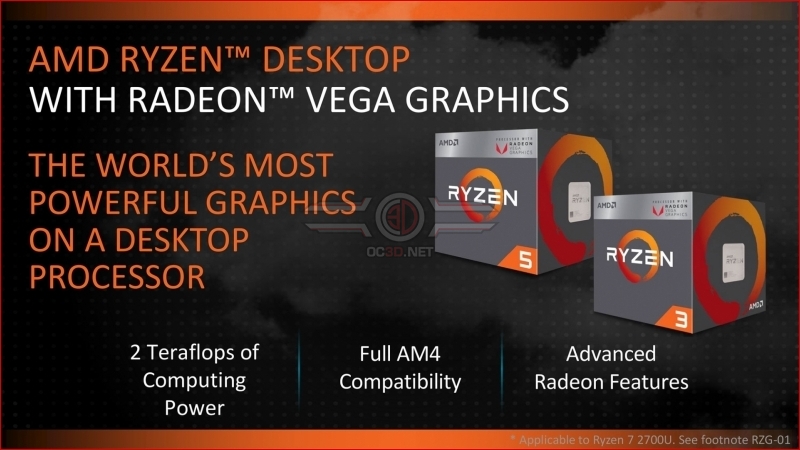
These two new APUs, AMD CPUs with integrated Graphics for those that don’t like shorthand names, will replace the company’s existing Ryzen 3 1200 and Ryzen 5 1400 CPUs, neither of which offers integrated graphics.
The Ryzen 3 1200 and Ryzen 5 1400 both use a cut-down version of AMD’s 8-core Ryzen 7 1800X, making them an inefficient design when it comes to die space, as half of the product is deactivated. With Raven Ridge, had decided to make a dedicated quad-core CPU design with an integrated graphics component, allowing Ryzen PCs to be built without a dedicated graphics card and ship quad-core CPUs without as much deactivated/wasted die space.
Raven Ridge will offer higher clock speeds than their standard Ryzen counterparts, though both the 2200G and 2400G will offer less L3 cache, which will have a performance consequence. This change is counteracted by the products use of precision boost 2 and its higher clock speeds, though it is a notable downgrade.
The 2200G and 2400G will also offer fewer PCIe lanes for GPUs, offering eight lanes instead of the sixteen that are provided on AMD’s enthusiast desktop Ryzen parts. Both chips will have an additional four lanes for an M.2 SSD and four lanes for the chipset, the same as other Ryzen CPUs, though the use of only eight PCIe lanes does limit the GPU and Add-in card options of Raven Ridge users.
TBH, Raven Ridge users would be insane to use this CPU for SLI or Crossfire, so the real-world problems here are limited, though it is a change that is worth noting.
| Ryzen 3 1200 | Ryzen 3 2200G | Ryzen 5 1400 | Ryzen 5 2400G | |
| CPU Socket | AM4 | AM4 | AM4 | AM4 |
| Manufacturing Process | 14nm | 14nm | 14nm | 14nm |
| Cores/Threads | 4/4 | 4/4 | 4/8 | 4/8 |
| CPU Base Clock | 3.1GHz | 3.5GHz | 3.2GHz | 3.6GHz |
| CPU Boost Clock | 3.4GHz | 3.7GHz | 3.4GHz | 3.9GHz |
| L2 Cache | 2MB | 2MB | 2MB | 2MB |
| L3 Cache | 8MB | 4MB | 8MB | 4MB |
| Memory Support (Dual Channel) | 2667MHz | 2933MHz | 2667MHz | 2933MHz |
| TDP | 65W | 45-65W | 65W | 45-65W |
| iGPU | N/A | Vega | N/A | Vega |
| iGPU Stream Processors | – | 512 | – | 704 |
| iGPU Clock Speed | – | 1100MHz | – | 1250MHz |
| PCIe Lanes for Dedicated Graphics | 16x | 8x | 16x | 8x |
| Included Heatsink | Wraith Stealth | Wraith Stealth | Wraith Stealth | Wraith Stealth |
| MSRP | $99 | $99 | $149 | $169 |
Given the small price changes when moving up to AMD’s Raven Ridge series processors, it is hard to see these products as anything but good value, as users are getting higher clock speeds and what is effectively a free integrated GPU component.